
Free template
Wedding videography contract template, free to copy
A complete wedding videography contract in plain English: coverage, the films you deliver and when, ceremony audio, music licensing, copyright and cancellations. It’s general, not written for one state, so fill in the brackets and adjust it to your packages.
Updated
Fill in everything in [brackets]. Wedding Day calls this an agreement, the word the app uses from the quote to the couple’s signing page; it’s the same document people search for as a videography contract.
Wedding Videography Contract
This Wedding Videography Agreement (the “Agreement”) is made on [date] between [business name] (the “Videographer”) and [client names] (together, the “Client”), for filming the Client’s wedding on [wedding date] at [venue].
1. Coverage and films
The Videographer will film the wedding for [number] hours, starting at the time in the final timeline, with [number] camera operators, and will deliver the films and services on the quote: [highlight film of 4–6 minutes, full ceremony, toasts].
Any service not listed on the quote is outside this Agreement unless both parties agree to add it in writing. Coverage beyond the booked hours, asked for on the day and when the Videographer is available, is charged at [hourly rate] per hour and is due within [7] days of the wedding.
2. Fees and payment
The fee for the services is [total fee], plus any sales tax that applies.
A non-refundable retainer of [retainer amount] is due when this Agreement is signed. The retainer reserves the wedding date, and the Videographer turns away other bookings for that date once it is paid. The retainer counts toward the total fee.
The remaining balance is due by [final payment date]. If a payment is late, the Videographer may pause work on the wedding until it is received. Services added after the final payment are due before the wedding day.
3. Before the wedding
At least two weeks before the wedding, the Client will share the final timeline, the moments they most want in their film, who is giving toasts and when, and any songs they would like in the film.
The Client will tell the Videographer about any venue or officiant rules that limit filming. The Videographer follows those rules, and coverage limited by them is not a breach of this Agreement.
4. Audio and the wedding day
The Videographer may place small wireless microphones on the officiant and the couple and record from the DJ’s or venue’s sound system where allowed. The Client will let the officiant, readers and DJ know. The Videographer is not responsible for audio that could not be recorded because a microphone or sound feed was refused or failed.
The Client will arrange the Videographer’s access to the venue for the times in the final timeline. For coverage of more than six hours, the Client will provide a meal, or a reasonable break to eat, for each member of the Videographer’s team.
The Videographer will do their best to film every moment on the Client’s list, but cannot guarantee any single moment: moments can be missed when the day runs late, a guest steps in the way or something happens out of view.
5. Editing and delivery
The Videographer edits the films in their own style. The films on the quote are delivered by download link within [twelve] weeks of the wedding. Raw footage is not delivered unless it is on the quote.
The Client may ask for [one] round of changes to the highlight film within [14] days of delivery; further changes are charged at [rate] per hour.
The Client should download the films and keep their own copy. The Videographer keeps a backup of the footage until the films are delivered and the footage for [period] after that.
6. Music
Music in the films is licensed for personal use. A song the Client chooses may be replaced with a similar licensed song when it cannot be licensed. Films with licensed music may be muted or blocked by some sites when shared with other music added.
7. Copyright and use of the films
The Videographer keeps the copyright in the footage and the films and grants the Client a license to share the films for personal use, including on social media. Commercial use needs the Videographer’s written permission.
The Videographer may use the films and stills from them in their portfolio, on their website and on social media. The Client may opt out by telling the Videographer in writing before the wedding.
8. Changes and cancellation
Changes to the coverage, the timeline or the venue should be sent to the Videographer as early as possible and confirmed in writing. The Videographer will do their best to accommodate changes but cannot guarantee services that were not booked.
The Client may cancel by written notice. The retainer is not refundable. If the Client cancels more than [90] days before the wedding, payments made beyond the retainer are refunded. If the Client cancels [90] days or less before the wedding, all payments made are non-refundable.
If the Client moves the wedding to a new date, the Videographer will try to keep the booking. Payments made carry over to the new date if the Videographer is available; if not, the change is treated as a cancellation.
9. If the Videographer can’t attend
If the Videographer cannot attend because of illness, emergency or another serious reason, they will try to arrange a qualified replacement acceptable to the Client. If no replacement is arranged, the Videographer will refund all payments made under this Agreement, and their responsibility is limited to that refund.
10. Events outside anyone’s control
Neither party is responsible for failing to perform because of events outside its reasonable control, such as severe weather, natural disasters, public health orders, government action or venue closure. In that case the parties will work in good faith to move the services to a new date; if that is not possible, payments beyond the retainer are refunded.
11. Liability
The Videographer is not responsible for the acts, omissions, products or services of the venue or of other vendors.
The Client is responsible for damage to the Videographer’s equipment caused by the Client or their guests.
The Videographer’s total liability under this Agreement, including for footage lost or damaged through equipment failure, is limited to the amounts the Client has paid under it. Neither party is liable for indirect or consequential damages.
12. General
This Agreement, with the quote and payment schedule it includes, is the entire agreement between the parties and replaces earlier discussions. Changes must be in writing and accepted by both parties. If any part of this Agreement is found unenforceable, the rest remains in effect. This Agreement is governed by the laws of the state where the Videographer has their principal place of business. Electronic signatures are as valid as handwritten ones.
By signing below, the parties agree to the terms of this Agreement.
Videographer: [name], [title], [business name]
Signature: ______________________ · Date: ____________
Client: [partner 1 name]
Signature: ______________________ · Date: ____________
Client: [partner 2 name]
Signature: ______________________ · Date: ____________
This template is a starting point, not legal advice. Laws differ from state to state, so have a lawyer review your agreement before you use it.
How to adjust it
Name the films. Write each film on your quote with its length: a highlight film, the full ceremony, the toasts, a teaser. Couples compare videographers by what they get, so be specific in section 1.
Decide on changes. One round of changes to the highlight film, asked for within two weeks, is the starting point. Say what counts as a change, for example a different song.
Plan the audio. Vows and toasts are what couples rewatch. Agree with the DJ before the day on a feed from their mixer, and put a microphone on the officiant.
Check your state’s rules on deposits and consumer contracts, and have a lawyer where you work read your final version once.
Who needs a copy
Both partners sign it and keep a copy. Your second camera operator needs the hours and sections 3 and 4. The DJ and the officiant need to know about microphones and the sound feed before the day.
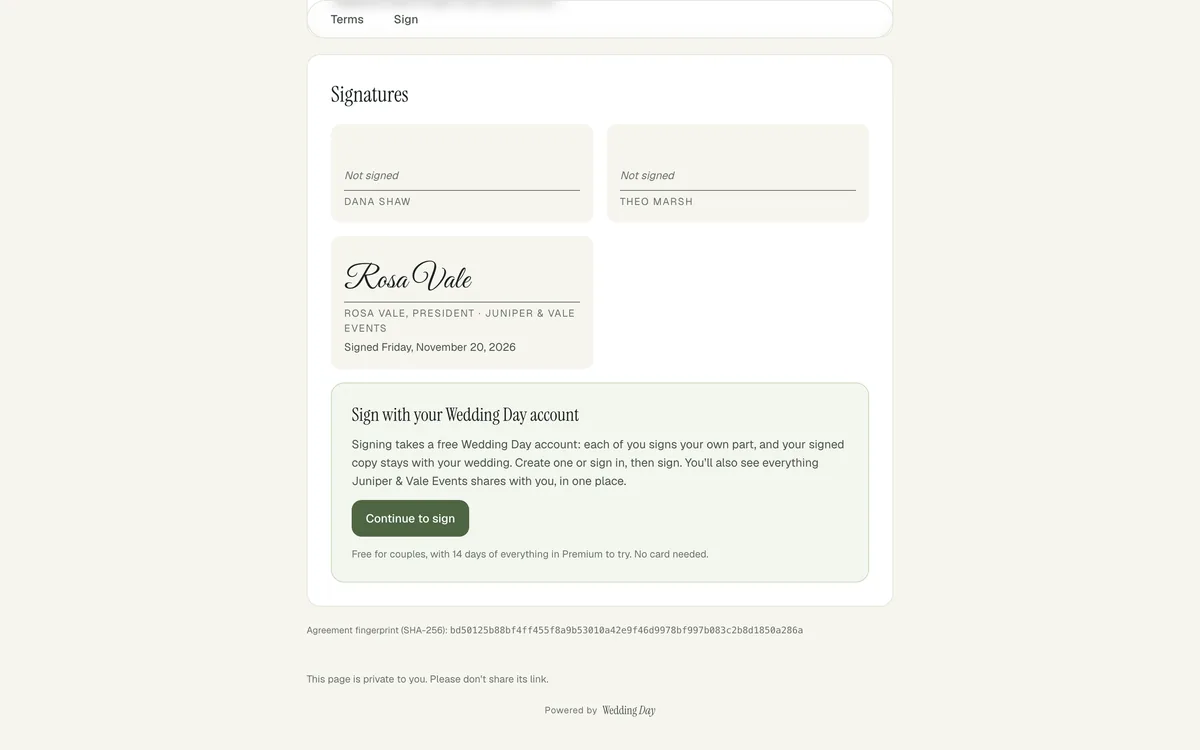
In Wedding Day, this is your agreement template, and new videography businesses start with one that has a videography paragraph in its scope of services. Turn a sent or accepted quote into an agreement and the couple’s names, the date, the venue, the fee and the payment dates fill in from the quote. You sign first; the couple signs online, one or both partners, with a free Wedding Day account, and Send agreement & invoice puts the invoice on the same link. The wedding day form you send the couple starts with getting-ready times, the key moments, family groupings and must-have shots; add your own questions, such as who’s giving toasts and the songs they’d like in their film.
Questions
What should be in a wedding videography contract?
Who it’s between, the date and venue, the hours of coverage, the films you deliver and how long each runs, the delivery time, how many rounds of changes are included, music licensing, who owns the footage and how the couple may share it, raw footage, cancellation, what happens if you can’t attend, liability and both signatures.
How do you write a videography contract?
Start from a template like this one and change three things to match how you work: the films and their lengths (section 1), the delivery time and changes (section 5), and your cancellation dates (section 8). Then have a lawyer where you work read your final version once.
Do wedding videographers give you the raw footage?
Usually not, unless it’s on the quote. This template says raw footage isn’t delivered unless the quote includes it, so a couple who wants it can add it as a paid extra.
Can you use any song in a wedding film?
Not legally: most popular songs need a license for use in a video. Many videographers use music licensed for personal use from a music library, which is what section 6 of the template says, and replace a couple’s song when it can’t be licensed.
Keep reading